GRC material is glassfibre reinforced concrete: a thin cement and fine silica sand mortar reinforced with alkali-resistant (AR) glass fibres instead of steel bars. Because the fibres run through the whole section, GRC can be cast or sprayed into skins only 12 to 20 mm thick that are strong in bending, non-combustible and far lighter than precast concrete.
Table of Contents
ToggleWhat Is GRC Material? Full Form and Meaning
The GRC full form is Glassfibre Reinforced Concrete.
In practical terms, GRC material meaning comes down to this: a cement-rich composite in which short AR glass fibres carry the tensile stress. With no rebar, there is no cover to maintain and nothing to rust, which explains the thin sections, fine detail and low weight. For the history and a broader overview, see What Is GRC? A Complete Technical Guide. Here we focus on the material itself.
GRC Material Composition and Mix Design
GRC material consists of a few raw ingredients. GFRC material composition is identical, but each ingredient is tightly specified. If you change the water content or the fibre dose slightly, then the resulting panel behaves differently.
Cement: OPC or White Portland Cement
Most GRC is made with Ordinary Portland Cement (OPC). White Portland cement is used where the panel needs a light, bright or strongly pigmented finish, since its low iron content gives a cleaner base colour. White cement costs noticeably more, so on large facades we often use it only in the facing coat and back it up with a grey OPC mix, provided the two are designed to shrink compatibly. However, many manufacturers report that using white cement is easier for colour preservation and production consistency, even for the grey shaded panels.
Silica Sand
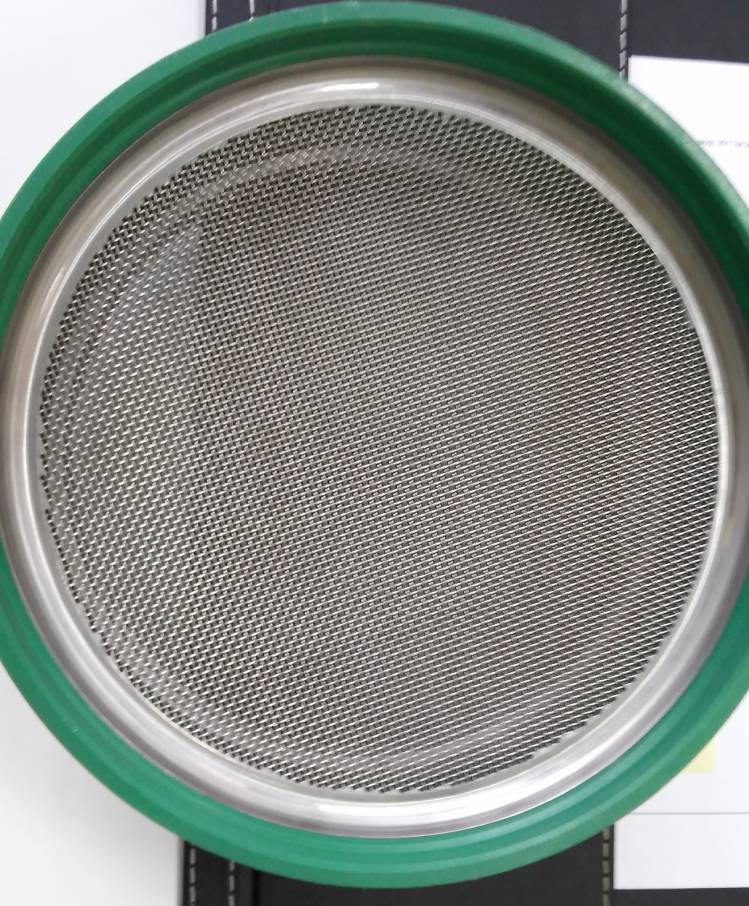
The fine aggregate is normally a washed, dried silica sand, not building sand. The GRCA Specification requires that less than 10% of the sand passes a 150 micron sieve, and that particles are round or irregular with a smooth surface. Maximum particle size is typically limited to about 1.2 mm for spray mixes and 2.4 mm for premix. The sand to cement ratio usually sits around 1:1 by weight, within the GRCA guide range of 0.5 to 1.5.
AR Glass Fibre and Its Zirconia Content
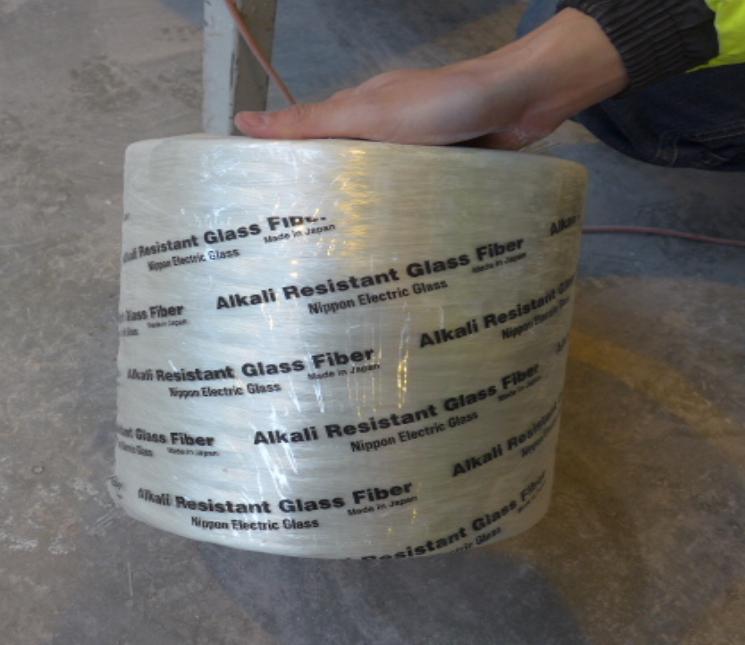
Ordinary E-glass, the fibre in fibreglass boats, is attacked by the alkaline pore water of Portland cement. AR glass survives because it contains zirconium dioxide (ZrO₂). The GRCA sets a minimum of 16% ZrO₂, and commercial AR fibres generally contain around 16 to 19%. Fibres should conform to BS EN 15422 and EN 14649 Category B, and the producer should be able to show you the certificate.
Fibre content is expressed as a percentage of the total wet mix by weight:
- Hand spray (Grade 18): the GRCA guide range is 4.0 to 5.5%, and most cladding is sprayed at around 5%.
- Premix (Grades 8 and 10): 2.0 to 3.5%, typically 2 to 3% for vibration-cast work.
Fibre length differs too. Spray guns chop continuous roving at the nozzle, usually to somewhere in the 25 to 40 mm range, while premix uses pre-cut chopped strand, commonly 12 or 13 mm. For more detail on fibre chemistry and degradation mechanisms, see our article on AR glass fibre in GRC.
Polymer, Admixtures, Pozzolans and Metakaolin
Acrylic polymer. Most architectural GRC is now polymer-modified (the “P” grades). An aqueous acrylic co-polymer dispersion is added at 4 to 7% polymer solids by weight of cement. It forms a film that holds water in the matrix, which allows dry curing instead of seven days in a humid curing room, and it reduces surface crazing.
Admixtures. Superplasticisers give the slurry enough flow to spray or cast at a water to cement ratio of roughly 0.30 to 0.38. Adding water to make a mix easier to spray is one of the quickest ways to ruin GRC, so workability is controlled chemically and checked with a slump test before production.
Pozzolans and metakaolin. Metakaolin, silica fume and fly ash can replace part of the cement. They consume calcium hydroxide from hydration, lowering alkalinity around the fibres and refining the pores; metakaolin is widely used to improve long-term strength retention. Iron oxide pigments add colour, and the acceptable colour range should be agreed before production.
Typical GRC Mix Proportions
| Parameter | Grade 18 / 18P (spray) | Grade 10 / 10P (premix) | Grade 8 / 8P (premix) |
|---|---|---|---|
| Aggregate/cement ratio | 0.5–1.5 | 0.5–1.5 | 0.5–1.5 |
| Water/cement ratio | 0.30–0.38 | 0.30–0.38 | 0.30–0.40 |
| AR glass fibre (% of total mix) | 4.0–5.5% | 2.0–3.5% | 2.0–3.0% |
| Polymer solids (% of cement, P grades) | 4–7% | 4–7% | 4–7% |
| Minimum bulk dry density | 1,800 kg/m³ | 1,800 kg/m³ | 1,800 kg/m³ |
Guide values from the GRCA Specification. Mixes outside these ranges can be acceptable, but they should be tested before use.
How GRC Materials Is Manufactured and Moulded
The production method has as much influence on the finished properties as the mix. The GRCA recognises two main routes.
Hand Spray (Simultaneous Spray)
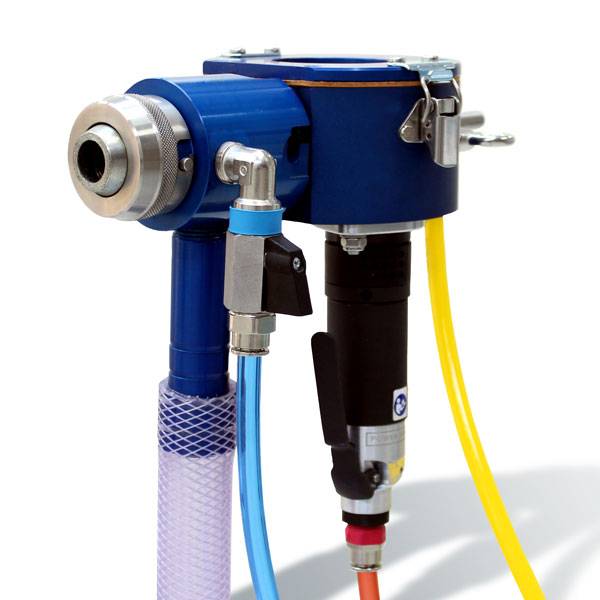
A concentric spray gun delivers cement slurry and freshly chopped fibre through the same nozzle. The sprayer first applies a fibre-free mist coat, then builds the GRC up in passes of roughly 3 to 4 mm, compacting each one with a serrated roller before the next goes on. A 12 mm panel therefore takes three or four passes. Because the fibres land flat, they lie mostly in the plane of the panel, which is why sprayed GRC gives the highest flexural strength and is the default for cladding.
Before every spray shift the gun is calibrated with the “bag and bucket” tests, which measure fibre and slurry output so the ratio can be set, and thickness is checked across the finished panel with a depth gauge. It is slow, skilled work, and the main reason sprayed GRC costs more than poured concrete.
Premix: Vibration-Cast
In premix, the slurry is first made in a high-shear mixer, then pre-cut fibres are folded in at low speed so they are not damaged. The mix is poured into moulds and compacted on a vibrating table or with external vibrators. Fibres sit in three dimensions, so strength is lower than sprayed GRC, but premix suits small, intricate and repeated pieces such as copings, sills, balusters and decorative mouldings.
Moulding GRC: What the Mould Decides
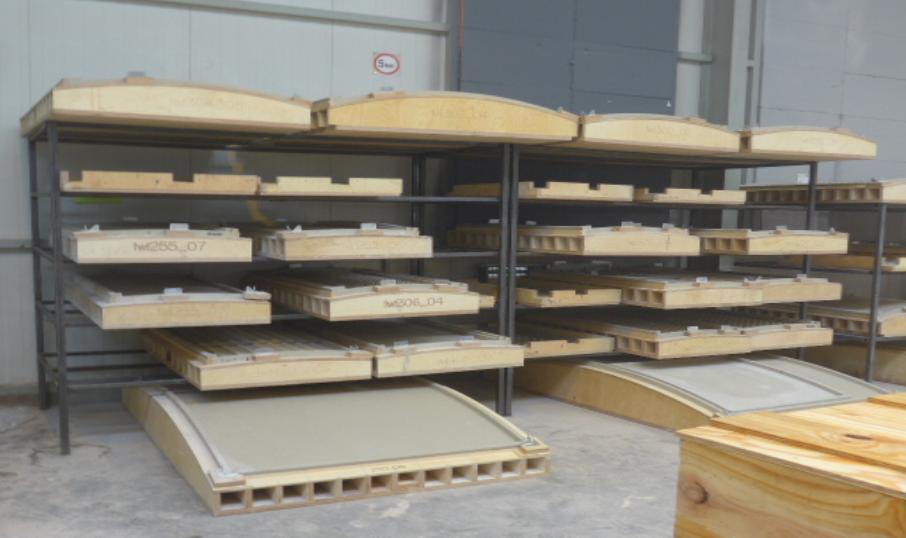
GRC copies the mould face exactly, including every scratch and imperfection. Moulds are commonly made from plywood or timber for simple short runs, steel for long repetitive runs, GRP for large curved forms, and polyurethane or silicone rubber liners where there is deep texture or undercut. Good GRC material moulding practice includes slightly rounded internal corners, draft angles that let the piece release without stress, and a design that does not restrain early shrinkage. In our experience, a large share of production problems trace back to the mould rather than the mix. Our GRC moulds guide and how GRC panels are made go through this step by step.
Curing finishes the job. Non-polymer GRC needs around seven days at about 95% relative humidity and 20°C. Polymer grades are covered overnight in the mould, then protected from drying wind and heat for a couple of days.
GRC Material Properties
The table below gives typical 28-day values. They are ranges, not guarantees. GRC is specified by grade, and any project-specific design should use the producer’s own test data.
| Property | Sprayed GRC | Premix GRC |
|---|---|---|
| Dry bulk density | 1,800–2,100 kg/m³ | 1,800–2,000 kg/m³ |
| Flexural strength, LOP | 5–10 N/mm² | 5–10 N/mm² |
| Flexural strength, MOR | 18–30 N/mm² | 5–14 N/mm² |
| Characteristic values by grade (LOP / MOR) | Grade 18: 7 / 18 N/mm² | Grade 10: 6 / 10; Grade 8: 5 / 8 N/mm² |
| Ultimate tensile strength | 8–12 N/mm² | 3–6 N/mm² |
| Compressive strength | 50–80 N/mm² | 40–60 N/mm² |
| Modulus of elasticity | 10–20 GPa | 10–20 GPa |
| Charpy impact strength | 15–25 N·mm/mm² | 7–12 N·mm/mm² |
| Water absorption | 8–13% | 8–13% |
| Coefficient of thermal expansion | 10–20 × 10⁻⁶ /°C | 10–20 × 10⁻⁶ /°C |
| Thermal conductivity | 0.5–1.0 W/mK | 0.5–1.0 W/mK |
| Shrinkage (1:1 mix) | About 0.03% irreversible, about 0.12% total | Similar |
| Reaction to fire (BS EN 13501-1) | A1 non-combustible (some polymer mixes A2-s1, d0) | A1 non-combustible (some polymer mixes A2-s1, d0) |
| Freeze-thaw | Good without air entrainment | Good without air entrainment |
| Typical skin thickness | 10–15 mm, up to about 20 mm | Varies with element |
| Weight of skin | About 20 kg/m² per 10 mm | About 20 kg/m² per 10 mm |
LOP and MOR in Plain Terms
GRC is classified by flexural strength, not compressive strength. The limit of proportionality (LOP) is the stress at which the load and deflection curve stops being straight, the point where microcracking starts. The modulus of rupture (MOR) is the peak stress before failure. Design stresses are kept below LOP. The gap between LOP and MOR is the material’s ductility, and that is the property that changes most with age.
Fire Performance
Generic polymer and non-polymer GRC tested for the GRCA in 2017 was classified A1, non-combustible, under BS EN 13501-1, based on BS EN ISO 1182 and BS EN ISO 1716 tests. The GRCA notes that some polymer mixes have come out as A2-s1, d0, so ask for the report covering the actual mix. Our GRC fire rating article sets out the test data.
Movement
Thermal and moisture movement drive joint and fixing design. The GRCA recommends allowing 1 to 1.5 mm per meter of panel dimension, so up to 4.5 mm on a 3 m panel.
Weight Compared with Precast
A 10 mm GRC skin weighs about 20 kg/m². Even with a steel stud frame, a finished GRC cladding panel typically lands somewhere between 35 and 85 kg/m², against roughly 250 to 600 kg/m² for architectural precast concrete. That difference is what makes smaller cranes, lighter brackets and refurbishment overcladding possible.
The Standards That Govern GRC Material
A well-written GRC material specification should reference these documents:
- BS EN 1169: general rules for factory production control of glassfibre reinforced concrete.
- BS EN 1170: test methods for GRC, including bending strength (LOP and MOR), water absorption and dry density, and dimensional variation due to moisture. The older eight-part 1998 series also covered slump, wash-out fibre content and sprayed fibre content.
- BS EN 15422: specification of glass fibres for reinforcing mortars and concretes.
- EN 14649: the SIC strength retention test for glass fibres in cement.
- GRCA Specification for the Manufacture, Curing and Testing of GRC Products, which sets the grades, mix guides, test frequencies and compliance rules.
- GRCA Methods of Testing and the GRCA Practical Design Guide, which covers limit state design, panel types and fixings.
BS EN 1169 and BS EN 1170 were both revised in 2024, so check which edition your project specification refers to.
Specifying GRC Material
A good GRC specification starts from performance. Pick the grade from the engineering, confirm polymer or non-polymer, state the finish and colour range, and require production and testing to the GRCA Specification. The GRCA also advises using a Full Member manufacturer, as Full Members are independently assessed every year.
The most common mistake we see is a specification that asks for “GRC to architect’s approval” and nothing else. That leaves strength, testing and tolerances open to interpretation until something goes wrong.
GRC Material Submittal Checklist
If you are reviewing a GRC material submittal, or preparing one, this list covers what a main contractor or facade consultant will normally expect:
- Mix design with grade (8, 10 or 18, with or without P), water to cement ratio, fibre content and polymer dosage
- AR glass fibre certificate confirming ZrO₂ content and conformity with BS EN 15422
- Data sheets for cement, sand, polymer, admixtures and pigments
- Recent LOP and MOR results, with characteristic values calculated from at least 40 test board means
- Wash-out (fibre content), density and water absorption results
- BS EN 13501-1 fire classification report relevant to the mix
- Quality management evidence: GRCA Full Member certificate, ISO 9001, or both
- Structural calculations for wind load, self-weight, handling and movement
- Shop drawings with panel build-up, thicknesses, fixings and joint widths
- Fixing and anchor details, with any pull-out or load test data
- Manufacturing tolerances, normally to GRCA techNOTE 13
- Finish samples, an agreed colour range and, on larger jobs, a mock-up panel
- Handling, storage, transport and repair method statements
GRC Material in Construction and on Facades
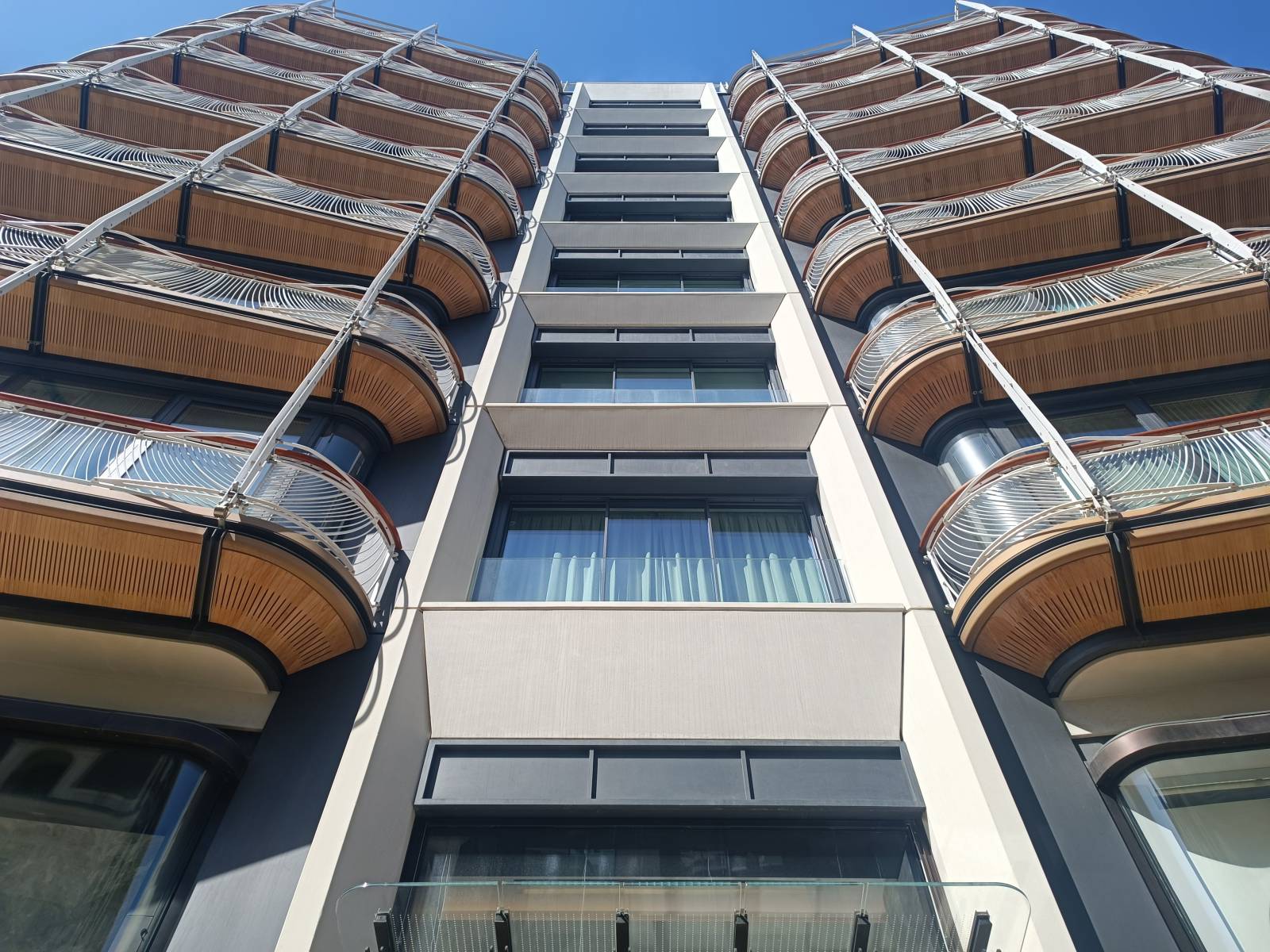
GRC material in construction covers everything from drainage channels and permanent formwork to planters. As a GRC building material for architecture, its biggest use in the UK, and the one we work in, is the facade.
Cladding Panels, Fins, Column Covers and Cornices
The typical facade GRC material applications we produce are:
- Cladding panels: flat, ribbed or curved rainscreen panels, usually Grade 18 sprayed for anything over about 1 m² of face area.
- Fins and brise soleil: deep vertical or horizontal profiles where low weight keeps brackets small.
- Column covers: two or more shells that wrap a structural column, often joined with hidden fixings.
- Cornices, copings and mouldings: heritage and new-build detailing where GRC replaces stone at a fraction of the weight.
Finishes range from smooth ex-mould to acid-etched, exposed aggregate and photocatalytic surfaces. Our article on GRC surface finishes shows the options.
The Substructure Frame and Fixings
Small panels can be single-skin with stiffening ribs and cast-in sockets. Larger panels, usually anything above 3 to 4 m², are built as stud-frame panels: a galvanised or stainless steel frame connected to the GRC skin by flex anchors, which take wind load but let the skin move, and gravity anchors, which carry the weight. The frame then fixes back to the building through adjustable brackets.
The GRCA rule is simple: do not over-restrain GRC, because a fixing that stops the panel moving will crack it. For site-side details, see our GRC cladding installation case study.
GRC Compared with GFRC, GRP and Precast Concrete
GRC and GFRC materials are one and the same, so the useful comparison is with GRP and precast concrete.
| Factor | GRC / GFRC | GRP | Precast concrete |
|---|---|---|---|
| Matrix | Cement and silica sand | Polyester or other resin | Cement, sand and coarse aggregate |
| Reinforcement | AR glass fibre | E-glass fibre | Steel bar or mesh |
| Typical thickness | 10–15 mm | Thin laminate, a few mm | Typically 100 mm or more |
| Weight | Low | Very low | High |
| Reaction to fire classification | A1 (A2 for some polymer mixes) | Combustible resin, cannot reach A1 | A1 |
| Look and feel | Genuine concrete or stone | Can imitate, but reads as plastic up close | Genuine concrete |
| Corrosion risk | None from reinforcement | None | Depends on cover and carbonation |
| Typical uses | Facades, heritage, complex shapes | Low-risk features, canopies, interiors | Structural and heavy cladding |
For external walls on relevant buildings in England, the Building Regulations require materials to achieve A2-s1, d0 or A1, which rules out most GRP on those projects. Precast remains the better choice where you need structural capacity, very large spans or a simple repetitive panel. Our GRC vs precast concrete article goes further on weight and whole-system cost.
Ageing and Durability of GRC Material
GRC durability has one honest caveat. In wet or cyclically wet conditions, the MOR and the strain to failure fall over time as hydration products grow around and between the glass filaments. LOP stays broadly stable or rises slightly. Early GRC from the 1970s, made with first-generation fibres and plain cement matrices, lost much of its ductility this way, and that history still comes up in design reviews.
Modern GRC answers this three ways: better AR fibres and sizings, matrix modification with polymer or metakaolin, and design based on predicted long-term properties, with stresses kept below LOP rather than relying on the 28-day MOR. Add the absence of steel and very slow carbonation, and well-made GRC is routinely designed for long service lives. Our article on GRC durability covers freeze-thaw, salt and UV exposure in more depth.
GRC Material Price: What Drives It
There is no single GRC material price, and a rate per m² quoted without drawings is a guess. The raw mix is a small part of the cost. These factors move a quote:
- Repetition: a mould spread over 200 casts costs far less per panel than one used four times.
- Geometry: returns, curves, undercuts and deep reveals add spraying time and mould complexity.
- Production method and grade: hand-sprayed Grade 18 takes longer than vibration-cast premix.
- Finish: white cement, pigments, exposed aggregate, acid etching and photocatalytic coatings all add material and labour.
- Panel build-up: stud frames, insulation and cast-in fixings add fabrication cost.
- Testing and documentation: mock-ups, load tests and extra fire evidence.
- Logistics and installation: crating, access, cranage and site conditions.
Our guide to GRC cladding cost per m² breaks this down further. The quickest way to an accurate number is to send drawings, quantities, finish and fixing strategy, and we will price against them.
GRC Material FAQ
What is the full form of GRC?
GRC stands for Glassfibre Reinforced Concrete. It is also called glass reinforced concrete, glass fibre reinforced concrete or GFRC, and older documents may say glass-fibre reinforced cement.
What is GRC material made of?
Portland cement (grey or white), fine silica sand, water and alkali-resistant glass fibres, usually with an acrylic polymer, a superplasticiser and sometimes pozzolans such as metakaolin and pigments.
What is the difference between GRC and GFRC material?
There is none. GFRC is the North American name for the same composite. Both use AR glass fibres in a cement and sand matrix.
How thick are GRC panels?
Most GRC cladding skins are 10 to 15 mm thick, and some larger or more heavily loaded elements go to around 20 mm. Stiffness comes from ribs, returns or a steel stud frame rather than extra thickness.
What is the fire rating of GRC material?
GRC is non-combustible. Generic GRC formulations tested for the GRCA achieved Euroclass A1 under BS EN 13501-1. Some polymer-modified mixes are classified A2-s1, d0, so check the report for the specific mix. Fire resistance of an assembly depends on the whole build-up.
What are the main GRC material properties?
Typical sprayed GRC: dry density 1,800 to 2,100 kg/m³, MOR 18 to 30 N/mm², LOP 5 to 10 N/mm², compressive strength 50 to 80 N/mm². It is graded by characteristic MOR as Grade 8, 10 or 18.
Which standards apply to GRC?
BS EN 1169 for production control, BS EN 1170 for test methods, BS EN 15422 for the glass fibres, and the GRCA Specification, Methods of Testing and Practical Design Guide.
How much does GRC material cost?
It depends on mould repetition, geometry, finish, panel build-up, testing and installation far more than on the raw mix. A project-specific quote based on drawings is the only reliable figure.
Talk to Us About Your GRC Project
If you are working up a specification or checking a submittal, we are happy to review mix designs, panel build-ups and fixing strategies with you, and to provide weights and test data for your design team. Get in touch here and send us your drawings.